Connecting Departments and Communities
Part 5 of 5 — FireTEXT®: What’s New & What’s Next
For the past several days, we’ve shared what’s changing across FireTEXT®.
We’ve talked about the platform itself, dispatching, responder-focused weather, and the technology behind FireTEXT Signal.
For the final part of our What’s New & What’s Next series, we want to look beyond the emergency response itself.
We want to talk about the community.
Fire departments do much more than respond when someone calls 911. They provide safety information, recruit volunteers, host community events, answer questions, issue notices, help residents prepare for emergencies, and serve as trusted local resources.
We believe FireTEXT® can help strengthen that connection.
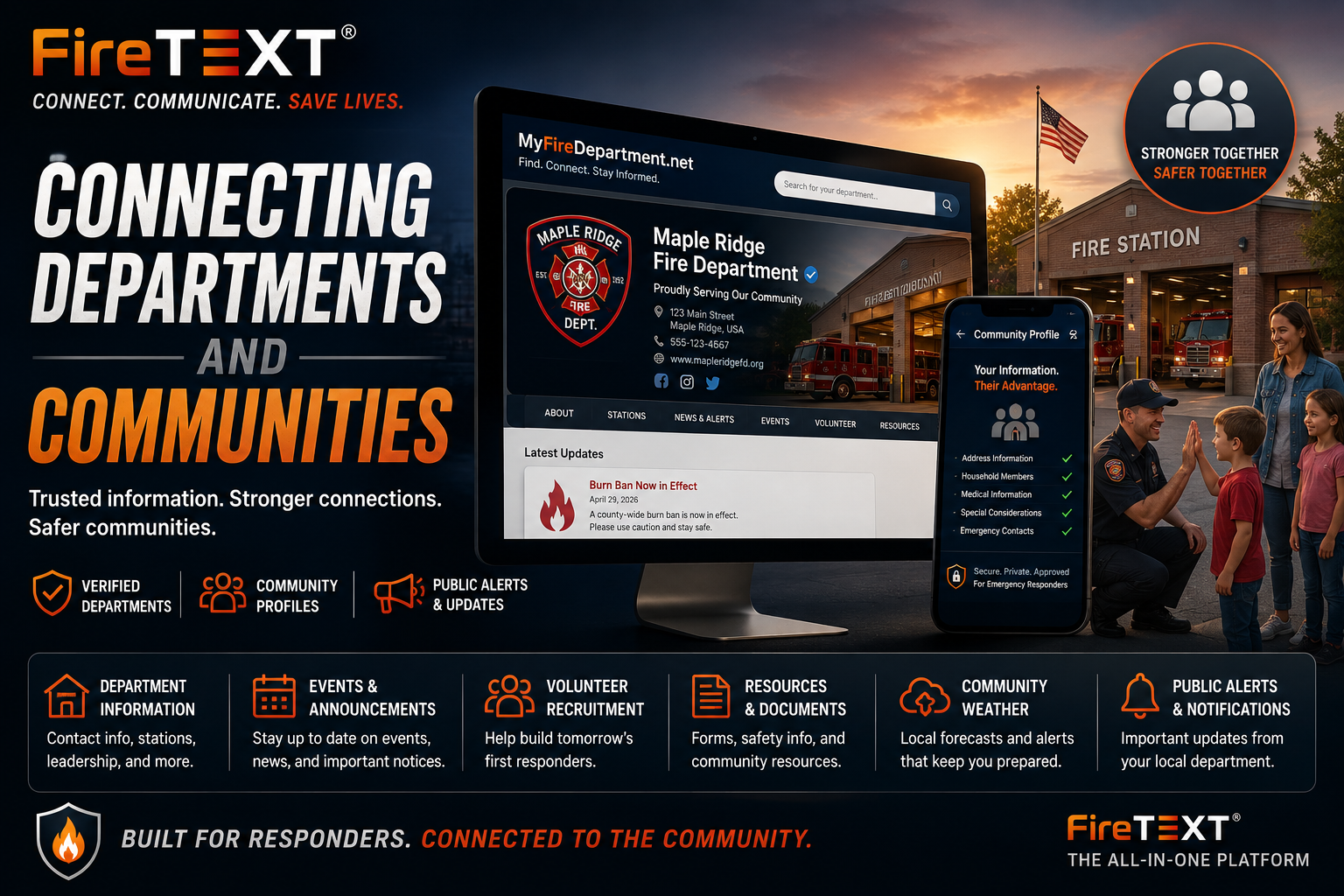
That’s the idea behind FireTEXT® Community and MyFireDepartment.net.
And we want to be very clear from the beginning:
This is not about turning the responder side of FireTEXT® into a social network.
Responder operations and sensitive information must remain protected.
Instead, we’re working toward a separate, public-friendly experience where departments can share trusted information with the communities they serve.
As with every article in this series:
🟢 Available Now — Released and usable
🟡 Rolling Out — Being introduced or expanded
🔵 In Development — Actively being built and tested
⚪ Looking Ahead — Part of our future direction
A Verified Home for Your Department
🔵 In Development
One of the central ideas behind FireTEXT® Community is simple:
Every participating department should have a trusted, verified place online.
Today, people searching for their local fire department may find information scattered across search engines, social media pages, county websites, old directories, or third-party websites.
Some of that information may be outdated.
Phone numbers change.
Leadership changes.
Stations move.
Websites disappear.
Social media pages become inactive.
We believe departments should have a simple way to maintain their own trusted public information.
That is part of what we’re building.
MyFireDepartment.net
🔵 In Development
MyFireDepartment.net is being developed as a public-facing destination for finding and connecting with local fire departments.
A department page could provide information such as:
- Department name
- Department logo
- Verified status
- Station locations
- Public phone number
- Website
- Social media
- Department information
- Volunteer or career status
- Community announcements
- Events
- Recruitment information
- Public resources
The goal is not to replace a department’s existing website or Facebook page.
Instead, MyFireDepartment.net can provide another trusted place where residents can find accurate information about the department serving them.
Verified Department Profiles
🔵 In Development
Verification will be an important part of the Community experience.
Anyone can create a website or social media page that looks official.
We want residents to be able to recognize when information is actually connected to the department it represents.
Verified department profiles could help establish that trust.
Once a department is appropriately verified, authorized department personnel could manage the public information associated with their organization.
That gives departments more control over how they are represented while helping residents identify trusted local information.
FireTEXT® Community
🔵 In Development
MyFireDepartment.net is only one piece of a larger idea.
We’re also developing the foundation for FireTEXT® Community.
Community is intended to provide a simpler public experience built around the relationship between local organizations and the people they serve.
Rather than giving public users access to the responder console, Community would have its own interface, permissions, terminology, and purpose.
That separation is important.
A resident checking a community notice does not need access to responder tools.
A firefighter responding to an emergency does not need public-community features getting in the way.
The two experiences can work together without becoming the same thing.
Community Profiles
🟢 Foundations Available / 🔵 Continuing Development
One area we’re especially interested in is Community Profiles.
Residents and businesses can provide certain information that may be useful to responders during an emergency.
For example, an approved profile could potentially help identify information associated with a property before or during a response.
The important word here is:
Approved.
Information intended for responders should not automatically become public simply because it was submitted through a community service.
Privacy, permissions, verification, and appropriate access must remain part of the design.
The goal is to give responders useful information when appropriate—not create a public database of private household information.
Helping Residents Prepare Before the Emergency
⚪ Looking Ahead
There is also an opportunity to make Community useful before an emergency ever occurs.
A department could eventually provide residents with resources such as:
- Burn-ban information
- Severe-weather preparedness
- Smoke-alarm information
- Fire-prevention tips
- Evacuation information
- Hydrant and water-supply notices
- Seasonal safety information
- Emergency preparedness resources
- Department contact information
Instead of residents trying to determine which social media post or website is current, the department could have a trusted place for important community information.
Department Announcements
🔵 In Development
Departments frequently need to communicate information that isn't an emergency dispatch.
Examples might include:
- Road closures
- Controlled burns
- Burn bans
- Water issues
- Severe-weather information
- Station events
- Training notices
- Public safety reminders
- Community meetings
- Fundraisers
- Recruitment announcements
FireTEXT® Community could give departments another way to publish and organize those notices for the people who choose to follow them.
Community Alerts
⚪ Looking Ahead
Looking further ahead, Community could also provide additional ways for residents to receive information from trusted local organizations.
The key difference between a responder dispatch and a community alert must remain clear.
A FireTEXT® responder alert is operational.
A Community notification is public information.
Those should not be treated as the same thing.
Keeping them separate allows us to build useful public communication tools without cluttering or weakening the systems responders depend on.
Volunteer Recruitment
🔵 In Development
Volunteer departments across the country continue to face recruiting challenges.
Many residents may not know:
- Their local department needs volunteers
- What positions are available
- Whether experience is required
- How to apply
- What training is provided
- Who to contact
A verified department profile could give departments a straightforward place to explain how someone can get involved.
That could include firefighters, medical responders, support members, junior programs, auxiliary members, or other opportunities defined by the department.
For some communities, helping one new volunteer find the department could make the entire service worthwhile.
Events and Community Engagement
⚪ Looking Ahead
Fire departments are part of their communities long before the tones drop.
Departments host:
- Open houses
- Fundraisers
- Fire-prevention events
- Training demonstrations
- Smoke-detector programs
- Community meetings
- Holiday events
- Recruitment events
- Public education programs
We believe these events deserve better visibility.
Community could eventually give departments a simple place to publish upcoming events and allow residents to discover what is happening locally.
More Than Fire Departments
⚪ Looking Ahead
While fire departments are the natural starting point, communities include many organizations that residents depend on.
Over time, the Community platform could potentially support verified profiles for organizations such as:
- EMS
- Emergency management
- Law enforcement
- Cities and counties
- Schools
- Utilities
- Churches
- Community organizations
- Other public-service partners
We are not announcing that every one of these organizations will become part of the platform.
We are building the foundation in a way that gives us room to explore those possibilities.
Community Weather
⚪ Looking Ahead
Earlier this week, we talked about responder-focused weather.
Community creates another opportunity.
The weather information a firefighter needs during an active incident is different from what a resident needs while preparing for a storm.
Future Community weather capabilities could focus on things such as:
- Local conditions
- Severe-weather information
- Department weather notices
- Preparedness information
- Community-specific alerts
- Event weather
Again, the goal isn't to replace dedicated weather authorities.
It is to help departments communicate trusted, relevant information alongside the other resources their communities use.
Keeping Emergency Information Separate
This may be the most important part of the entire Community project.
Public access cannot come at the expense of responder privacy or operational security.
FireTEXT® contains information intended for emergency personnel.
That information should not automatically become part of a public Community experience.
As Community grows, we intend to maintain clear separation between:
Responder information
and
Public information.
That means separate permissions, appropriate verification, and careful decisions about what information can move between the two sides of the platform.
Community should strengthen FireTEXT®.
It should never compromise it.
Keeping Community Accessible
⚪ Looking Ahead
We also want to think carefully about how Community services are funded.
Our goal is to make useful public information accessible without putting unnecessary barriers between residents and their local departments.
That could eventually involve a combination of department participation, county or municipal support, sponsorships, grants, partnerships, and optional community contributions.
A resident should not have to pay simply to view basic public safety information from their local department.
If voluntary community support becomes part of the platform, it should be exactly that:
Voluntary.
Someone choosing to contribute a few dollars to help support the service would not make the public service itself a paid service.
It would help support keeping that access available.
The business model is something we'll continue exploring carefully as Community develops.
Why Build This?
Because the relationship between a department and its community shouldn't begin when someone calls 911.
FireTEXT® already helps departments communicate during emergencies.
We believe there is an opportunity to help them communicate before and after those emergencies, too.
A resident may visit because they want to know about a burn ban.
Someone else may be looking for their local fire station.
A business owner may want to provide useful emergency information.
A family may be preparing for severe weather.
Someone may be thinking about volunteering for the first time.
All of those interactions can strengthen the connection between a department and the people it protects.
What's Available Today
🟢 Available Now
Some of the technical foundations for Community Profiles and responder access to approved information are already being developed into the existing FireTEXT® ecosystem.
These foundations give us a starting point.
But the complete Community experience described in this article should not be interpreted as fully launched today.
There is still work to do.
And we would rather be clear about that than make Community sound finished before it is ready.
What We're Building
🔵 In Development
Current Community development is focused around the core foundation:
- FireTEXT® Community
- MyFireDepartment.net
- Verified department profiles
- Community Profiles
- Public department information
- Department-managed content
- Public-friendly navigation
- Privacy and permission separation
- Recruitment and community information
We'll continue refining these ideas as the platform develops.
Looking Ahead
⚪ Looking Ahead
The bigger vision is a trusted local public-safety network built around the organizations already serving their communities.
Not another social network.
Not another place filled with unrelated content.
Not a replacement for 911.
And not a public version of the responder console.
Something simpler:
A trusted connection between communities and the organizations that serve them.
Responders First. Community Connected.
FireTEXT® began with emergency communications.
That remains at the center of what we do.
The tools we build for responders must remain dependable, focused, and protected.
Community represents an opportunity to extend the value of FireTEXT® beyond the station and beyond the active call—while keeping that responder mission intact.
We have a lot more work ahead of us.
Some ideas will change.
Some will improve.
Some may never make it beyond testing.
And new ideas will come directly from the departments and communities we serve.
That's why we've called this series:
FireTEXT®: What's New & What's Next
Because FireTEXT® isn't finished.
We're continuing to build it.
And we're excited about where it can go next.
Thank You for Following the Series
Over the past five parts, we've shared a look at:
Part 1 — The FireTEXT® Platform Is Evolving
Part 2 — Dispatch Faster
Part 3 — Weather That Works for Responders
Part 4 — Inside FireTEXT Signal
Part 5 — Connecting Departments and Communities
Thank you to every firefighter, dispatcher, chief, emergency manager, department administrator, and customer who continues to provide feedback and help shape FireTEXT®.
We're building what's next together.