
Weather That Works for Responders
Weather That Works for Responders
Part 3 of 5 — FireTEXT®: What's New & What's Next
Weather affects every emergency response.
Whether you're responding to a structure fire, a vehicle accident, a medical emergency, a wildfire, or a severe storm, changing weather conditions can quickly influence responder safety, apparatus operations, fire behavior, road conditions, and incident strategy.
Traditional weather apps are designed for the general public.
First responders need something different.
They need weather information that helps answer one question:
"How will today's weather affect this response?"
That philosophy is driving the evolution of weather throughout the FireTEXT® platform.
Instead of treating weather as a separate feature, we're integrating operational weather awareness directly into dispatching, active incidents, responder workflows, and future community communications.
As with every article in this series, we'll clearly identify the status of each feature.
- 🟢 Available Now — Released and usable
- 🟡 Rolling Out — Released gradually or still being enabled
- 🔵 In Development — Actively being built and tested
- ⚪ Looking Ahead — Part of our long-term vision
Weather That Supports Operations
🟢 Available Now
FireTEXT® weather is becoming more than a forecast.
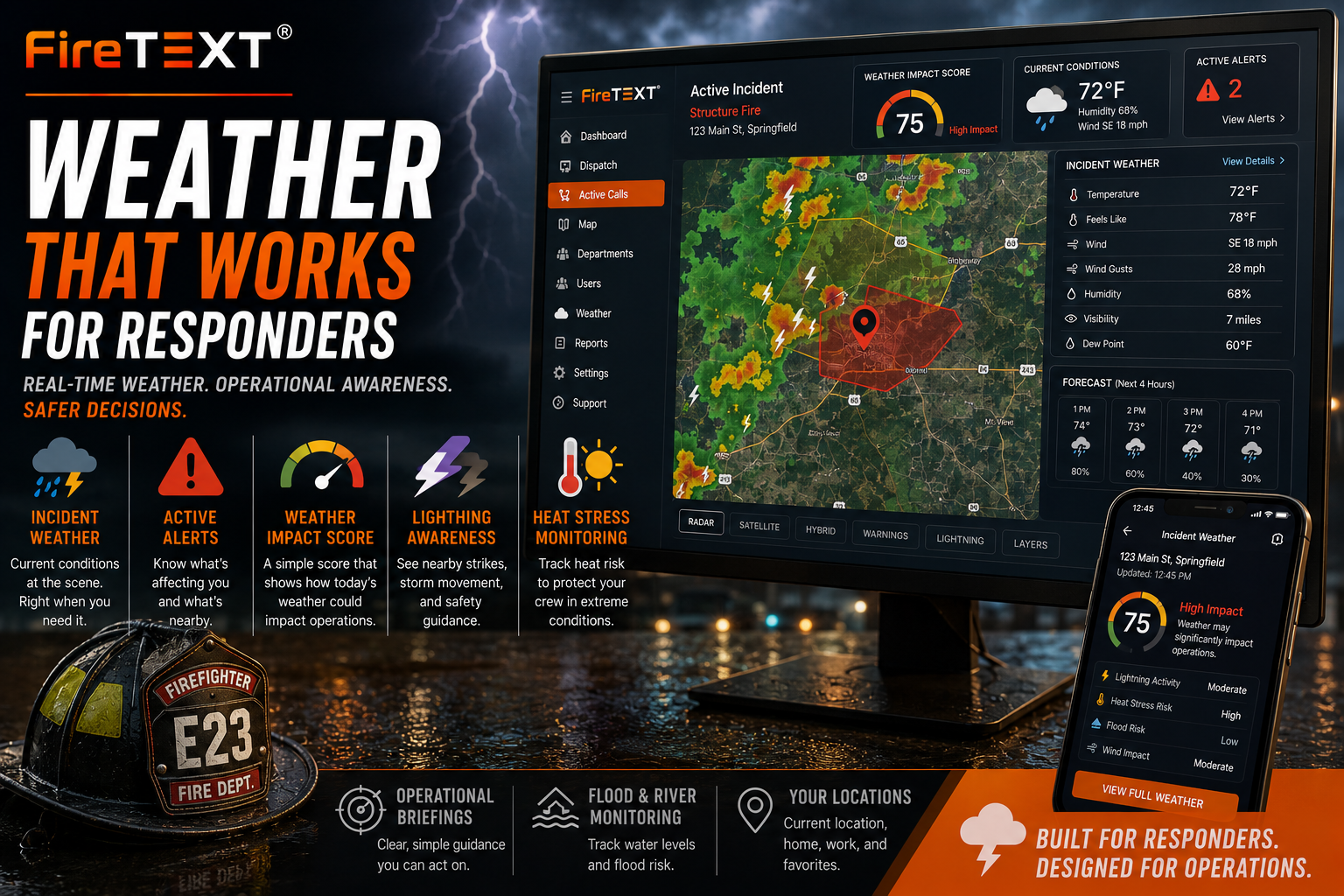
Instead of simply displaying temperature and precipitation, the platform is designed to provide responders with operational context before they arrive on scene.
Weather information is now appearing throughout the platform, including:
- Dashboard
- Active Calls
- Dispatch Workflow
- Station Displays
- Weather Center
- Mobile App
The goal is to reduce the need to switch between multiple weather applications while responding to an emergency.
Incident-Based Weather
🟢 Available Now
Every active incident can include weather information specific to the dispatch location.
Responders can quickly review:
- Current conditions
- Temperature
- Wind speed and direction
- Humidity
- Visibility
- Forecast
- Active weather alerts
Having weather attached directly to the incident helps responders understand conditions before arriving on scene.
Weather Alerts That Matter
🟢 Available Now
Not every warning affects an incident the same way.
FireTEXT® distinguishes between:
- Weather alerts directly affecting the incident
- Alerts elsewhere in the county
- Nearby developing weather
That distinction helps responders better understand operational risk without creating unnecessary confusion.
For example, a Tornado Warning ten miles away may still be important, but it should not appear the same as a warning directly over the incident.
Weather Impact Score
🟡 Rolling Out
One of the most exciting additions is the Weather Impact Score.
Rather than forcing responders to interpret dozens of weather values, FireTEXT® combines multiple weather conditions into a simple operational score.
Factors may include:
- Wind
- Lightning
- Heavy Rain
- Extreme Heat
- Extreme Cold
- Visibility
- Flood Risk
- Fire Weather
- Severe Storms
Instead of asking,
"What is the weather?"
The platform begins answering,
"How difficult could today's weather make this response?"
Operational Briefings
🟡 Rolling Out
Weather data is valuable.
Operational guidance is even more valuable.
FireTEXT® is introducing weather briefings that summarize current conditions into responder-friendly language.
Examples include:
Moderate lightning risk within the response area.
Strong wind may affect aerial operations.
Extreme heat may increase firefighter fatigue.
Heavy rainfall may reduce visibility and create standing water on roadways.
Instead of requiring responders to interpret every weather value themselves, the system provides practical context.
Lightning Awareness
Rolling Out
Lightning is one of the leading weather hazards for emergency responders.
FireTEXT® is expanding lightning awareness to include:
- Nearby lightning activity
- Distance from incident
- Storm movement
- Operational recommendations
- Lightning trend monitoring
Our goal isn't simply to report lightning.
It's to help responders make safer decisions while operating outdoors.
Crew Heat Stress
🟡 Rolling Out
Firefighters routinely operate in environments far hotter than the outside temperature.
Even so, environmental heat remains an important contributor to responder fatigue.
The Crew Heat Stress indicator combines environmental conditions into a simple operational awareness tool.
Departments can quickly recognize when additional hydration, rehab, or personnel rotation may be appropriate.
River and Flood Monitoring
🟡 Rolling Out
Flooding creates unique challenges for emergency services.
Future weather improvements continue expanding visibility into:
- River levels
- Flood watches
- Flood warnings
- Flash flooding
- Water trends
- Nearby gauges
This information is especially valuable for departments operating in flood-prone areas.
Weather Radar
🟡 Rolling Out
The Weather Center continues expanding interactive radar capabilities.
Future improvements include:
- Faster radar updates
- Better overlays
- Warning polygons
- Storm tracks
- Future precipitation
- Cleaner mobile viewing
Radar is one of the most requested weather features, and we continue refining the experience.
Home and Favorite Locations
🟡 Rolling Out
Weather shouldn't always require selecting a department.
Future updates allow weather to center around the user.
Supported locations may include:
- Current GPS location
- Home
- Work
- Favorite locations
- Saved stations
- Frequently viewed areas
This makes weather more useful even when a responder isn't currently assigned to an active incident.
Better Mobile Weather
🔵 In Development
We're continuing to redesign the mobile weather experience.
Areas of focus include:
- Faster loading
- Cleaner layout
- Improved radar
- Better alert visibility
- More operational information
- Easier location switching
- Improved maps
- Additional forecast tools
The goal is to create a weather experience specifically for emergency responders—not simply another weather app.
Statewide Weather Awareness
🔵 In Development
FireTEXT® continues exploring broader weather awareness beyond individual incidents.
Future capabilities may include:
- Statewide alert maps
- Regional weather summaries
- Incident clusters
- Multi-county severe weather tracking
- Emergency operations visibility
This information can help agencies preparing for widespread weather events.
Weather for the Community
⚪ Looking Ahead
Weather information will also become an important part of FireTEXT® Community.
Community members may eventually receive:
- Local weather conditions
- Community weather alerts
- Department weather notices
- Event weather
- School weather information
- Public safety recommendations
The goal is not to replace the National Weather Service.
The goal is to present trusted weather information alongside official community communications.
Why Weather Matters
Every emergency response is influenced by weather.
Wind affects fire behavior.
Lightning threatens crews operating outdoors.
Heat increases firefighter stress.
Ice changes road conditions.
Flooding blocks access.
Heavy rain reduces visibility.
FireTEXT® is evolving to present this information where responders already work instead of requiring them to search for it during an emergency.
Built Around Real Operations
Many of these weather improvements began with a simple observation.
Responders weren't asking for another forecast.
They were asking:
- Is lightning close enough to be a concern?
- Is flooding likely to affect access?
- How strong is the wind?
- Will today's heat increase crew fatigue?
- Is severe weather moving toward the incident?
Those questions shaped the direction of FireTEXT® weather.
Looking Ahead
Weather will continue becoming more integrated across the FireTEXT® platform.
Our vision is to make weather part of operational awareness—not simply another screen users occasionally check.
As new weather capabilities are introduced, our priorities remain:
- Accuracy
- Simplicity
- Operational value
- Reliability
- Responder safety
Coming Tomorrow
Inside FirePITCH®
Tomorrow we'll take a behind-the-scenes look at FirePITCH® and the technology helping departments receive alerts faster, monitor radio systems, improve tone detection, and better understand the health of their dispatch infrastructure.
We'll cover:
- Tone Detection
- Stream Monitoring
- Calibration
- Recording Archives
- Detection Analytics
- Health Monitoring
- Radio Reliability
- What's coming next
Continue the Series
- Sunday: FireTEXT®: What's New & What's Next
- Monday: The FireTEXT® Platform Is Evolving
- Tuesday: Dispatch Faster: What's New & What's Coming Next
- Wednesday: Weather That Works for Responders
- Thursday: Inside FirePITCH®
- Friday: Connecting Departments and Communities